Thursday, September 19, 2013

Step By Step How to Brush Your Teeth-

  • Start with your upper molars (back teeth) on your left side and work in a clockwise direction. 
  • Point the bristles toward the gumline, in a 45-degree angle. Use a short circular motion for approximately 20 seconds. After 20 seconds, roll the brush head away from the gumline, so the bristles sweep the surface of the tooth, removing the food and plaque.
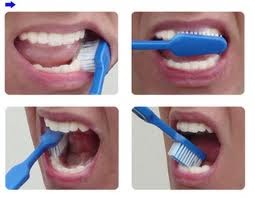

  • Continue working in a clockwise direction, ending with the lower molars on your left side. Repeat step two and three for the inside surface of the upper and lower molars.
  • Brush the lingual (back) surface of the upper-front teeth by using the tip of the toothbrush head. Direct the bristles toward the gumline, and use a flicking motion down the surface of the tooth. Do this 2 to 3 times.
  • Point the bristles of the tip of the toothbrush toward the gumline. Flick the bristles up, away from the gumline in a sweeping motion. Do this 2 to 3 times.
  • Brush the biting surface of the upper and lower premolars and molars, using a circular motion.
  • Using a gentle circular motion, brush your tongue for 30 seconds and the inside of your cheeks for 30 seconds. 
  • Finish by rinsing with either water or your choice of mouthwash.

 Don't forget to smile!

1-877-Dr Teeth- (360) 740-6212
Town Center Dental
3 Locations - Chehalis, Wa -- Rochester, Wa -- Rainier, Or

Saturday, September 14, 2013

What are the signs of gingivitis and/or serious gum disease?
Some of the possible signs of gingivitis and/or serious gum disease include:


  • Bleeding and red, swollen, or tender gums
  • Gums that have pulled away from the teeth.
  • Pus between the teeth and gums (when you press on the gums)
  • Bad breath
  • Permanent teeth that are loose or moving away from each other
  • Changes in the way your teeth fit when you bite
  • Changes in the fit of partial dentures or bridges                                                                                                                                                                              
            If you have any of the above, see your dentist.


1-877-Dr Teeth - (360) 740-6212
Town Center Dental
3 Locations - Chehalis, Wa -- Rochester, Wa -- Rainier, Or


Tuesday, August 20, 2013

Myth or Fact About Cavities?

Sugar Is the Prime Cause of Cavities

Myth, but it's almost a fact.

The truth is, acid produced by bacteria in your mouth is the cause of cavities, says Kimberly A. Harms, DDS, an American Dental Association consumer advisor and former president of the Minnesota Dental Association. However, these bacteria are triggered to make acid when you eat anything with carbohydrates -- and sugar is a carb.

Rice, potatoes, bread, fruits, and vegetables are also carbs.
Once the acid eats into your tooth, the bacteria “have a nice little hole to live in where your toothbrush and floss can’t reach,” says Harms. The bacteria continue to metabolize carbs and produce acids -- and your cavity just keeps getting bigger.

Here’s an important fact. It’s not the amount of carbs you eat that causes tooth decay, but the length of time your teeth are exposed. If you eat a lot of carbs for lunch, that’s one big exposure. But if you spend the day sipping sugary drinks, that’s continuous exposure -- and much more unhealthy for your teeth.


“We have a saying,” says Harms. “Sip all day and get decay.”


1-877-Dr Teeth- (360) 740-6212
Town Center Dental
3 Locations - Chehalis, Wa -- Rochester, Wa -- Rainier, Or


Friday, August 16, 2013

Tips for Caregivers


Saturday, August 10, 2013

Fluoride - What is Fluoride?


Fluoride, a naturally occurring mineral, is often added to drinking water and is commonly found in toothpaste. Research has shown that the rate of cavities decreases in areas where fluoride is added to the water supply. Health authorities, such as The American Dental Association and The World Health Organization, both advocate the addition of fluoride to drinking water, and recommend you use toothpaste that contains fluoride, if age appropriate.

If you do not have fluoride in your water, fluoride is also available in:
  • Tablets
  • Rinse
  • Varnish
  • Foam
Speak with your dentist if you are concerned whether or not you are receiving enough, or too much fluoride daily. Fluoride treatments are also given at your dental office after a cleaning appointment every six months to one year. 

1-877-Dr Teeth- (360) 740-6212
Town Center Dental
3 Locations - Chehalis, Wa -- Rochester, Wa -- Rainier, Or


Monday, July 29, 2013

When Should Dental Care Start?


Proper dental care begins before a baby's first tooth appears. Just because you can't see the teeth doesn't mean they aren't there. Teeth actually begin to form in the second trimester of pregnancy. At birth, your baby has 20 primary teeth, some of which are fully developed in the jaw.


Running a damp washcloth over a baby's gums daily will help clear away harmful bacteria.
Parents can brush kids' teeth as they come in with an infant toothbrush, using water with just a smear of toothpaste until about age 2.
Around age 2, most kids can spit while brushing. Use a pea-sized amount of toothpaste,
with supervision, until around age 5.
Even babies can develop tooth decay if good feeding habits aren't practiced. Putting a baby to sleep with a bottle might be convenient, but can harm the baby's teeth. When the sugars from juice or milk remain on a baby's teeth for hours, they can eat away at the enamel, creating a condition known as "bottle mouth". Pocked, pitted, or discolored front teeth are signs of bottle mouth. Severe cases result in cavities and the need to pull all of the front teeth until the permanent ones grow in.

Parents and childcare providers should help young kids set specific times for drinking each day because sucking on a bottle throughout the day can be equally damaging to young teeth.

1-877-Dr Teeth- (360) 740-6212
Town Center Dental
3 Locations - Chehalis, Wa -- Rochester, Wa -- Rainier, Or


Tuesday, July 2, 2013

Diabetes and Oral Health Problems

The more severe form of gum disease is called periodontitis. When you reach this stage, your gums begin to pull away from your teeth. Pockets form between your teeth and gums. These fill with germs and pus, and deepen. When this happens, you may need gum surgery to save your teeth. If nothing is done, the infection goes on to destroy the bone around your teeth. The teeth may start to move or get loose. Your teeth may fall out or need to be pulled.


Is There an Association Between Gum Disease and Diabetes?

For the nearly 26 million Americans who have diabetes, many may be surprised to learn about an unexpected complication associated with this condition. Research shows that there is an increased prevalence of gum disease among those with diabetes, adding serious gum disease to the list of other complications associated with diabetes, such as heart disease, stroke and kidney disease.


Is There a Two-Way Street?

Emerging research also suggests that the relationship between serious gum disease and diabetes is two-way. Not only are people with diabetes more susceptible to serious gum disease, but serious gum disease may have the potential to affect blood glucose control and contribute to the progression of diabetes. Research suggests that people with diabetes are at higher risk for oral health problems, such as gingivitis (an early stage of gum disease) and periodontitis (serious gum disease). People with diabetes are at an increased risk for serious gum disease because they are generally more susceptible to bacterial infection, and have a decreased ability to fight bacteria that invade the gums.
The Surgeon General's Report on Oral Health states that good oral health is integral to general health. So be sure to brush and floss properly and see your dentist for regular checkups.


If I Have Diabetes, am I at Risk for Dental Problems?

If your blood glucose levels are poorly controlled, you are more likely to develop serious gum disease and lose more teeth than non-diabetics. Like all infections, serious gum disease may be a factor in causing blood sugar to rise and may make diabetes harder to control.
Other oral problems associated to diabetes include: thrush, an infection caused by fungus that grows in the mouth, and dry mouth which can cause soreness, ulcers, infections and cavities.


How Can I Help Prevent Dental Problems Associated with Diabetes?

First and foremost, control your blood glucose level. Then, take good care of your teeth and gums, along with regular checkups every six months. To control thrush, a fungal infection, maintain good diabetic control, avoid smoking and, if you wear them, remove and clean dentures daily. Good blood glucose control can also help prevent or relieve dry mouth caused by diabetes.


What Can I Expect at My Checkup? Should I Tell My Dental Professional About My Diabetes?

People with diabetes have special needs and your dentist and hygienist are equipped to meet those needs - with your help. Keep your dentist and hygienist informed of any changes in your condition and any medication you might be taking. Postpone any non-emergency dental procedures if your blood sugar is not in good control.

http://www.diabetes.org/living-with-diabetes/treatment-and-care/oral-health-and-hygiene/diabetes-and-oral.html

1-877-Dr Teeth - (360) 740-6212
Town Center Dental
3 Locations - Chehalis, Wa -- Rochester, Wa -- Rainier, Or